Stair Lifts
Stair Lifts for Landings and Split-Level Stairs: Your Options
A landing in the middle of your stairs does not rule out a stair lift — but it does change the price and the design. Here are the four ways installers handle it.
Written by Sarah Jenkins
Reviewed by Elena Marsh
Updated August 27, 2026
Fact-checked August 27, 2026
3 min read
Editorial policyScroll the table sideways to see all columns.
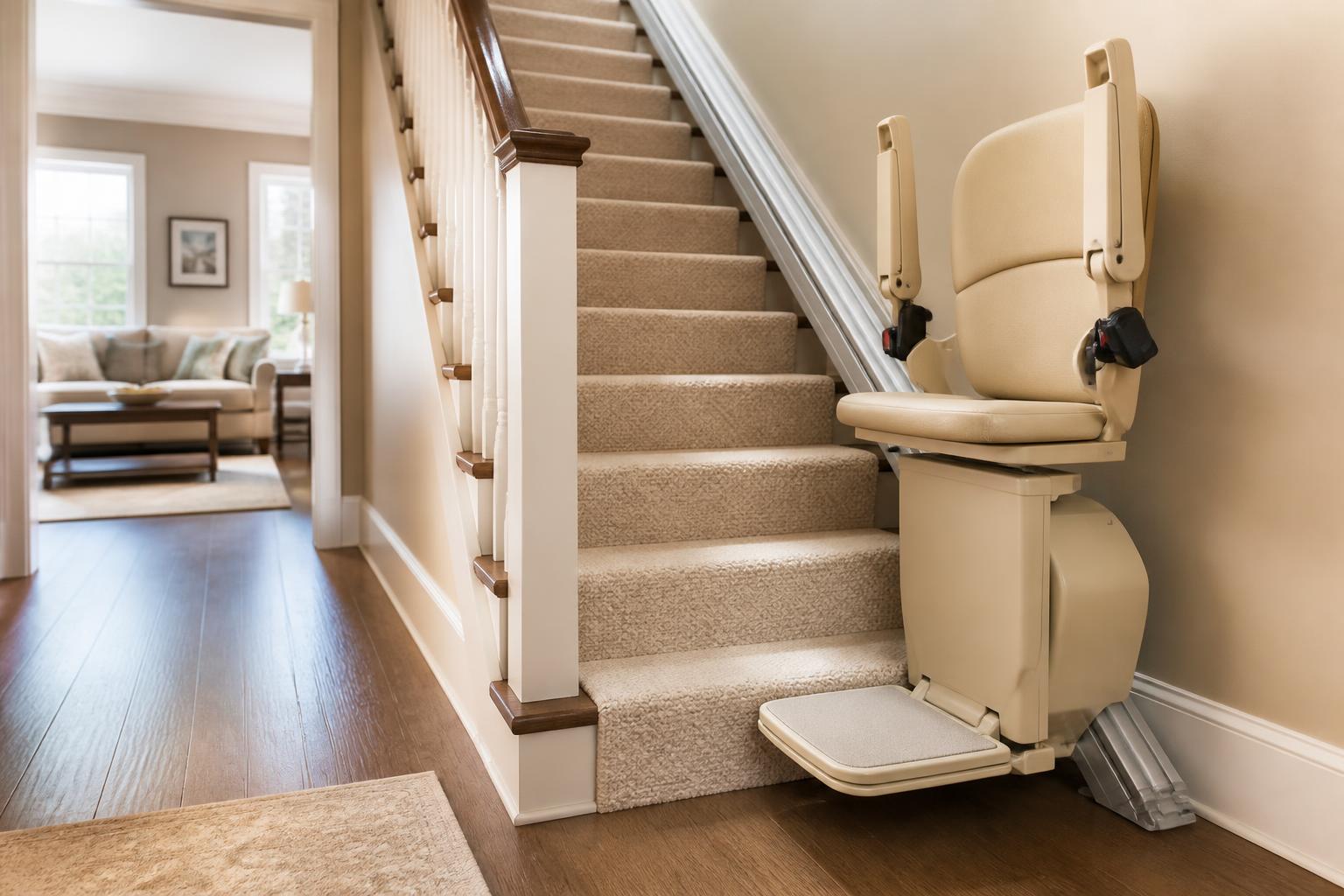
Option 1: One curved stair lift
A curved lift uses a rail custom-bent to follow your exact staircase — every turn, landing, and angle. The user rides the whole way without getting off, which makes it the safest and simplest choice for anyone with poor balance, dementia, or limited standing ability.
- The rail is built from measurements or a photographic survey of your stairs, so expect 4–8 weeks between order and installation.
- Because the rail fits only your staircase, curved lifts have almost no resale or buy-back value.
- The rail can often be designed to park around a corner or on the landing, keeping the stairs clear when not in use.
Option 2: Two straight stair lifts
If the landing is a flat rectangle between two straight flights, many installers will fit one straight lift per flight at roughly half the cost of one curved rail. The trade-off is the transfer: the user has to stand up on the landing, turn, and sit on the second lift.
Option 3: Park points and overruns
On curved installations, ask about two rail details that change daily life: an overrun (the rail finishes onto the landing so the user stands up on flat floor, not at the top step) and a park point (a charging stop around a corner so the chair waits out of the way). Both are easy to add during design and hard to add later.
Split-level homes: sometimes two problems, not one
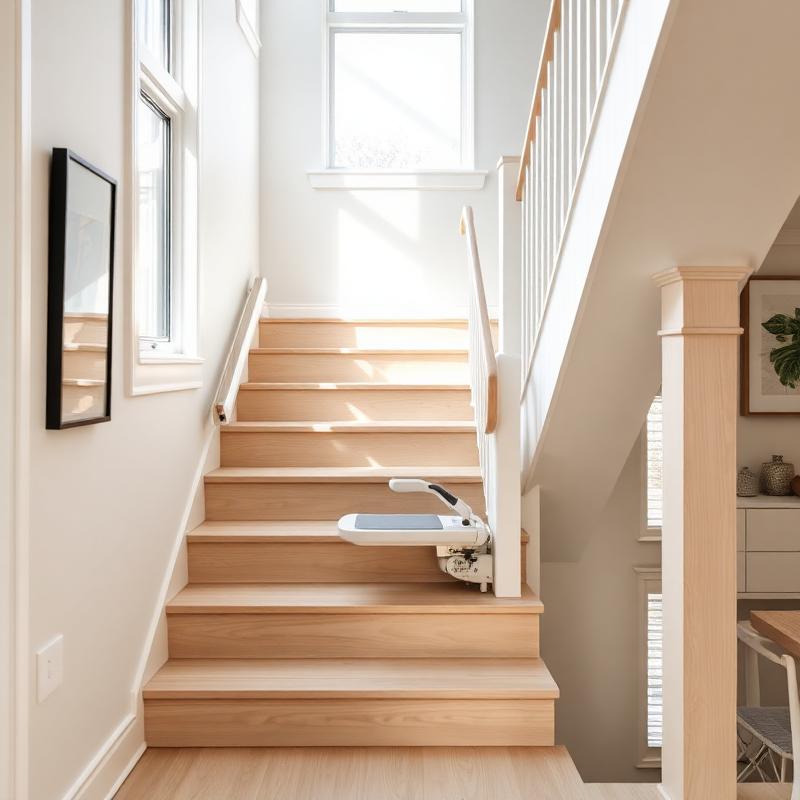
In a split-level or tri-level, the flights between levels are usually short and straight — often just 4 to 8 steps. That changes the math:
- Short straight flights are the cheapest lifts to install (sometimes reconditioned units are available).
- You may only need a lift on the flight you actually use daily — a split-level often has a level with a bedroom, bath, and kitchen on it, or one that can be converted.
- For a single short flight, compare the lift cost against a stair-climbing aid or simply reorganizing which floor is used for what.
Questions to ask the installer
- Can the rail park off the stairs or on the landing?
- Where does the user get on and off — flat floor or a step?
- If we choose two straight lifts now, does that complicate a curved rail later? (It doesn't — but the straight lifts have resale value only on the straight-flight market.)
- What is the narrowest point on the stairs with the lift folded, and can someone still walk past?
Can a stair lift go on stairs with a landing?
Yes. A curved rail can follow almost any staircase with adequate width (roughly 28–30 inches of clear tread is a common minimum), and landings are often used as parking or boarding points.
Is a curved stair lift worth the extra cost?
If the user cannot transfer safely on the landing, yes — the transfer is a fall risk at the most dangerous spot in the house. If the user transfers easily and budget is tight, two straight lifts are a legitimate, common choice.
How long does installation take?
Straight lifts install in a few hours. Curved lifts install in a day, but the rail itself takes 4–8 weeks to fabricate after the survey.
Keep reading
Sources
- Stair lifts and home safety — National Institute on Aging
Sarah Jenkins
Editor, Bathrooms & Remodeling
Sarah writes about accessible bathrooms, remodeling budgets, and the difference between a $6,000 shower and a $22,000 one. She reviews product specifications against real installation constraints and has toured more than fifty accessible remodels in progress.
Covers: Accessible bathrooms · Walk-in tubs · Remodel budgeting · Universal design
Make Your Home Safer and Easier to Live In
Practical home-accessibility advice, product comparisons, and cost guides delivered to your inbox.
No spam, no pop-ups. Unsubscribe any time.