Review
Handicare Freecurve Stair Lift Review
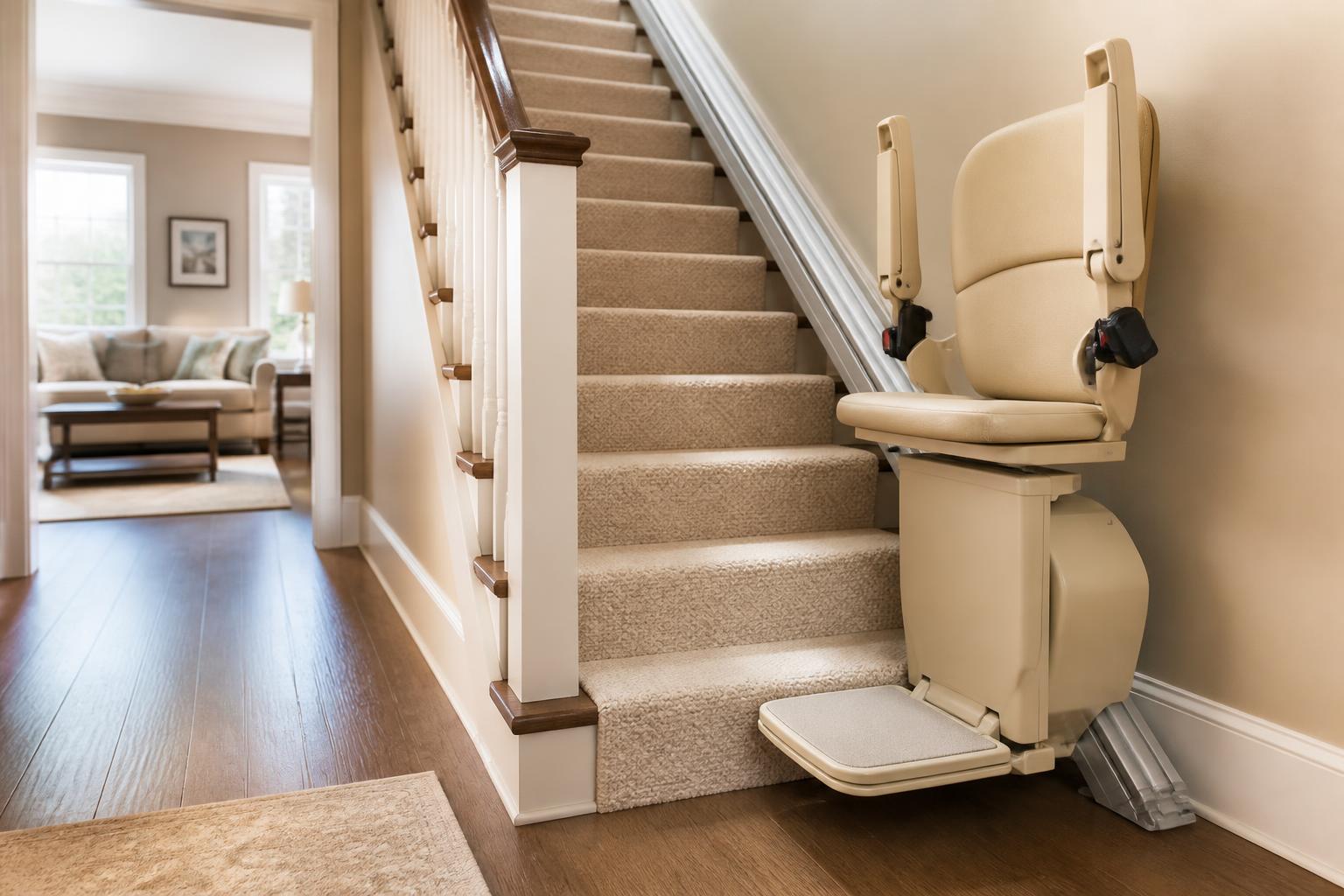
Built for the staircases other curved lifts struggle with. A wall-hugging rail that gives up as little walking width as possible.
Written by Marcus Thorne
Reviewed by Elena Marsh
Updated August 27, 2026
Fact-checked August 27, 2026
2 min read
Editorial policyOur Rating
4.3 / 5
Handicare Freecurve
Best for: Narrow curved staircases where every inch of clearance matters
On a narrow curved staircase the constraint is not the seat, it is how far the rail and carriage project into the walking path. The Freecurve's design goal is to keep that projection small, which is why dealers reach for it on staircases where a bulkier curved rail would make the stairs unusable for everyone else.
Price and lead time
Installed quotes commonly run $10,000 to $17,000. As with any curved lift, the rail is custom-fabricated, so plan on several weeks between the measurement visit and installation day.
Features
- 300 lb weight capacity
- Slim rail designed to hug the wall and minimize stair intrusion
- Custom-bent to follow landings, 90-degree and 180-degree turns
- Powered swivel and folding options
- Battery drive that keeps working in an outage
What to verify
- Ask for the folded intrusion in inches, measured on your staircase, written into the quote.
- Measure your stair width at its narrowest point and subtract that intrusion — what remains is the walking space for everyone else.
- Confirm where the lift parks at the top and bottom and whether it blocks a doorway.
- Ask who fabricates and who services the rail locally, and what a post-warranty call costs.
- Get a second curved quote. Rail pricing varies more between dealers than buyers expect.
Alternatives
Scroll the table sideways to see all columns.
Pros
- Slim wall-hugging rail is designed for tight curves and narrow flights
- Custom-bent rail can follow landings and 180-degree turns in one run
- Single continuous ride avoids a mid-stair transfer
- Rail can often be routed to park out of the walking path at the top or bottom
Cons
- Curved rail fabrication adds weeks of lead time
- Costs several times a straight installation
- Resale value is poor because the rail fits one staircase
- Measurement accuracy depends heavily on the local dealer
Who should buy it
Homeowners with a curved or narrow staircase who plan to stay in the home and cannot safely transfer on a landing.
Who should skip it
Anyone whose need is temporary, or households where the rider can comfortably walk across a landing between two straight lifts.
Bottom line
For a tight curve, the Freecurve is one of the few realistic answers. Judge the dealer's measuring process as carefully as you judge the product.
Frequently asked questions
How much does a Handicare Freecurve cost?
Typically $10,000 to $17,000 installed, depending on rail length, turns, and landings.
Will it fit my narrow curved staircase?
Often, but only an in-home measurement answers it. Get the folded intrusion figure for your stairs before comparing brands.
Is a curved lift worth it over two straight lifts?
Yes if the rider cannot safely stand, pivot, and walk across a landing. If they can, two straight lifts often deliver the same result for less.
Keep reading
Sources
- Manufacturer product and warranty documentation — Manufacturer materials
- Real Prices Paid submissions, 2025–2026 — Home Access Advisor
Marcus Thorne
Senior Editor, Mobility Equipment
Marcus covers stair lifts, home elevators, and platform lifts for Home Access Advisor. He spent eleven years estimating residential remodels before moving into consumer publishing, and he reads dealer quotes for a living — which is why most of his guides start with the line items other sites leave out.
Covers: Stair lifts · Residential elevators · Installation pricing · Dealer quotes
Make Your Home Safer and Easier to Live In
Practical home-accessibility advice, product comparisons, and cost guides delivered to your inbox.
No spam, no pop-ups. Unsubscribe any time.