Aging in Place
Lighting for Aging Eyes: Lumens, Color Temperature, and Night Paths
A 60-year-old eye needs roughly two to three times the light a 20-year-old eye needs to see the same detail — and most homes are lit for the 20-year-old.
Written by Elena Marsh
Reviewed by Sarah Jenkins
Updated August 27, 2026
Fact-checked August 27, 2026
6 min read
Editorial policyScroll the table sideways to see all columns.
Why older eyes need more light
Three changes happen with age at the same time. The lens of the eye yellows and lets less light through, the pupil does not open as wide, and the eye takes longer to adjust when moving between bright and dark rooms. The practical result is that a hallway that felt fine at 40 can feel dim and uncertain at 70, and the edge of a step can disappear entirely.
The fix is rarely one brighter bulb. It is more light, spread more evenly, with less glare and fewer sudden changes between rooms.
Lumens, not watts
Bulb packages still shout about watts out of habit, but watts measure energy use, not brightness. Lumens measure light output. A traditional 60-watt incandescent produced roughly 800 lumens; a 100-watt produced roughly 1,600. LED bulbs reach those numbers at a fraction of the wattage, so read the lumens line on the box.
Scroll the table sideways to see all columns.
Choosing color temperature
Color temperature is measured in kelvin and printed on the bulb box. Lower numbers look warm and yellow; higher numbers look cool and blue-white. Both extremes cause problems in a home.
- 2200K–2700K: very warm. Good for night lights and bedside lamps because it disturbs sleep less.
- 2700K–3000K: warm white. The default for living rooms, bedrooms, and hallways. Comfortable and familiar.
- 3500K–4000K: neutral to cool white. Best where you need to see detail — kitchen counters, laundry, bathroom mirror, workbench.
- 5000K+: daylight. Very bright-looking and often harsh in a home; some people find it improves contrast for reading, but it can feel clinical and increase glare complaints.
Keep color temperature consistent within a room. Mixing a 2700K lamp with a 4000K ceiling fixture makes both look wrong and makes the room feel patchy.
Glare is the bigger problem
Older eyes scatter light more inside the eye, so a bare bulb or a bright reflection off a glossy floor causes more disability than it would for a younger person. Adding brightness without controlling glare can make vision worse, not better.
- Use shades, diffusers, or frosted bulbs so no bare filament is visible from a seated position.
- Aim task lighting at the work surface, not at the person's eyes.
- Prefer matte finishes on floors and counters where you have a choice.
- Use sheer curtains or blinds to soften direct afternoon sun rather than blocking it entirely.
- Add light where light is missing instead of over-driving a single central fixture.
Room by room
Entries and hallways
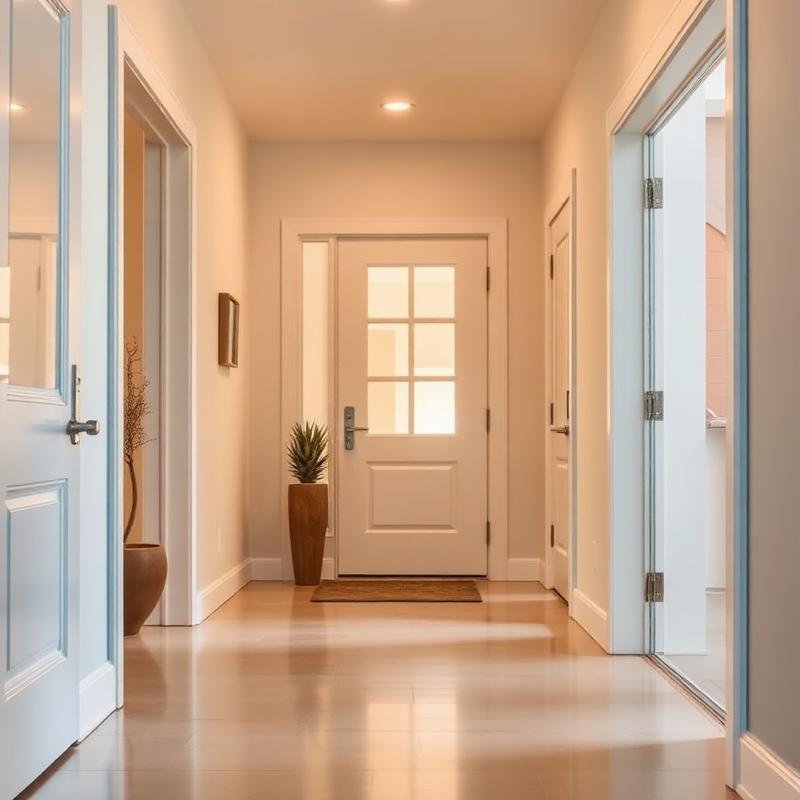
Light the transition. Coming in from bright daylight into a dim entry is where the eye's slow adaptation causes trips. Keep entry lighting bright and give hallways enough fixtures that there are no dark stretches between pools of light. Switches at both ends of a hallway mean nobody walks a dark corridor to reach a switch.
Stairs
Stairs need even illumination so every tread edge is visible, and three-way switches at the top and bottom. Avoid a single bright fixture at one end, which throws each tread's shadow onto the next and hides the step edges. Adding a contrasting strip on the front edge of each tread does as much for safety as the light itself.
Kitchen
Overhead lighting alone puts the cook's own shadow onto the counter. Under-cabinet lighting fixes this cheaply — LED strips or puck lights running the length of the work surface, on their own switch. Light the inside of deep pantries too, where motion-sensor battery lights work well without wiring.
Bathroom
Vanity light should come from both sides of the mirror at roughly face height. A single fixture above the mirror casts shadows down the face, which makes shaving, makeup, and checking skin harder. Add a separate light in or over the shower if the enclosure is dim.
Bedroom
Put a reachable light source within arm's reach of the bed — a touch lamp, a switched outlet, or a smart bulb with a bedside button. Nobody should have to cross a dark room to reach a wall switch after getting up at night.
Lighting the night path
The trip from bed to bathroom at 2 a.m. is one of the most common fall scenarios in the home. The goal is enough light to see the floor and the doorway, low enough that it does not fully wake the person or wreck their night vision on the way back.
- Place motion-activated lights low — under the bed frame, along the baseboard, or plugged into outlets near the floor.
- Use warm 2200K–2700K light. Bright white light at night is more disruptive to sleep.
- Light the full route: bedside, doorway, hallway, and inside the bathroom door.
- Choose motion sensors over switches so nothing has to be found in the dark.
- Keep an illuminated or lighted switch plate in the bathroom so the location is obvious from the hall.
What lighting cannot fix
Cataracts, macular degeneration, glaucoma, and diabetic eye changes all affect vision in ways that light levels only partly compensate for. If someone is struggling to see despite good lighting, an eye exam comes before another lighting purchase — treating a cataract often restores more function than any fixture.
Frequently asked questions
How many lumens does a living room need?
As a rough planning number, aim for 20 lumens per square foot of general lighting in a living room for older eyes — about 3,000 lumens total in a 12x14 room — delivered through several fixtures and lamps rather than one bright ceiling light. Add task lighting on top of that wherever someone reads or does handwork.
Are daylight bulbs better for older adults?
Sometimes for detailed tasks, rarely for whole rooms. High-kelvin daylight bulbs raise contrast but also raise perceived glare, and many people find them uncomfortable in living spaces. A reasonable compromise is warm light for general lighting and a neutral or daylight task lamp where fine detail matters.
Do smart bulbs help?
They can, mainly through scheduling and voice control — a hallway that turns itself on at dusk, or lights that respond to a spoken command from a chair. They also add a failure mode: if the app or Wi-Fi is down, the person still needs a working wall switch. Keep the manual switch functional.
What is the cheapest lighting improvement?
Motion-activated battery lights along the night path, plus replacing dim bulbs with higher-lumen LEDs in existing fixtures. Both cost very little, need no electrician, and target the two highest-risk situations: nighttime walking and dim stairs.
Keep reading
Sources
- Falls Prevention: Home Safety — CDC STEADI
- Aging and Your Eyes — National Institute on Aging
- HomeFit Guide — AARP
Elena Marsh
Reviews Lead, Aging in Place
Elena leads product reviews and the aging-in-place planning guides. Her background is in occupational therapy, and she focuses on matching equipment to actual transfer ability instead of to diagnosis labels or marketing categories.
Covers: Aging in place planning · Fall prevention · Transfer equipment · Bedroom setups
Make Your Home Safer and Easier to Live In
Practical home-accessibility advice, product comparisons, and cost guides delivered to your inbox.
No spam, no pop-ups. Unsubscribe any time.